

Psychology · Critical thinking and decisions
Thinking, Fast and Slow
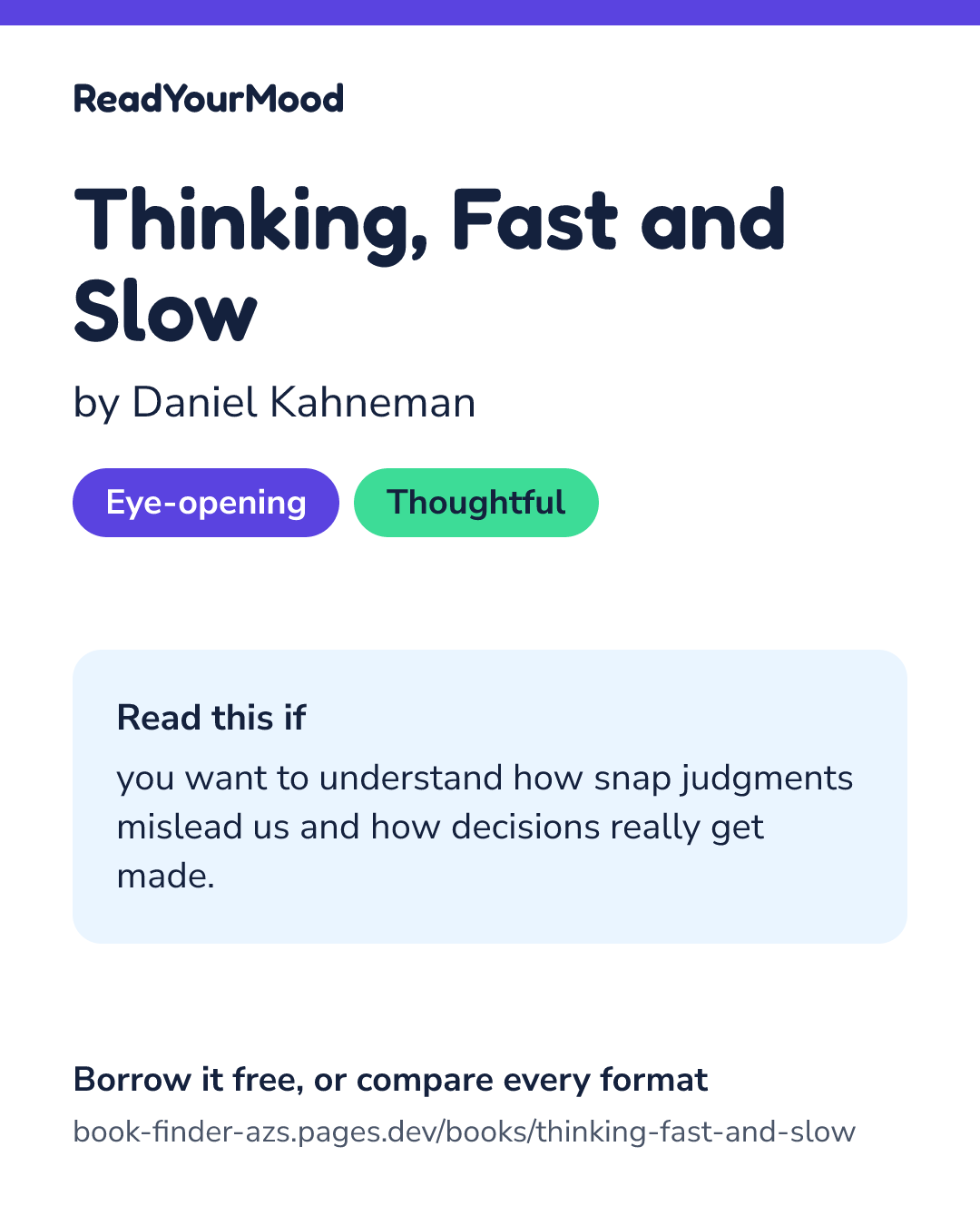
Nobel-winning psychologist Daniel Kahneman describes two modes of thought, one quick and intuitive, one slow and deliberate, and the biases and errors in judgment that come from how they interact.
Facts last checked 2026-10-17
- First published
- 2011
- Pace
- Slow
- Length
- Long
- Pages
- 499
- Format
- Standalone
Read this if you want to understand how snap judgments mislead us and how decisions really get made.
Skip this if you want a quick, light read, as it is long and dense.
The feel
Content warnings
None noted yet.
Quick answers about Thinking, Fast and Slow
- What is Thinking, Fast and Slow about?
- Nobel-winning psychologist Daniel Kahneman describes two modes of thought, one quick and intuitive, one slow and deliberate, and the biases and errors in judgment that come from how they interact.
- Who should read Thinking, Fast and Slow?
- Read it if you want to understand how snap judgments mislead us and how decisions really get made. Skip it if you want a quick, light read, as it is long and dense.
- How long and how fast is Thinking, Fast and Slow?
- It is a slow-paced, long read of about 499 pages, first published in 2011.
- Does Thinking, Fast and Slow have content warnings?
- We have not noted any content warnings for this book yet.
- Can I borrow Thinking, Fast and Slow for free?
- Often, yes. Check Libby (OverDrive) to see whether your library lends Thinking, Fast and Slow; the borrow button above searches it for you.
Your shelf
Saved in this browser only. Open my shelf
Where to get it
| Store | Price | Link |
|---|---|---|
| Borrow free | ||
| Libby / OverDrive | Free with a library card | Borrow free with Libby from Libby / OverDrive |
| Print, new | ||
| Bookshop.org | Check price | Buy new from Bookshop.org |
| Amazon | Check price | Buy new from Amazon |
| Ebook | ||
| Kobo | Check price | Buy ebook from Kobo |
| Google Play Books | Check price | Buy ebook from Google Play Books |
| Audiobook | ||
| Libro.fm | Check price | Buy audiobook from Libro.fm |
| Audible | Check price | Buy audiobook from Audible |
Prices appear here as retailer feeds are connected. Where none is shown, check the store. Links open the store in a new tab.
Some store links, including Kobo, are affiliate links: we may earn a commission if you buy, at no extra cost to you. Library links are never affiliate links. How this works
Share this pick
Psychology


